Is Mauna Kea Stargazing Worth It?
Yes for most adults, if you go to the summit for sunset. What a $255–$345 summit tour buys, who should skip it, and what the free Visitor Station still offers after dark.
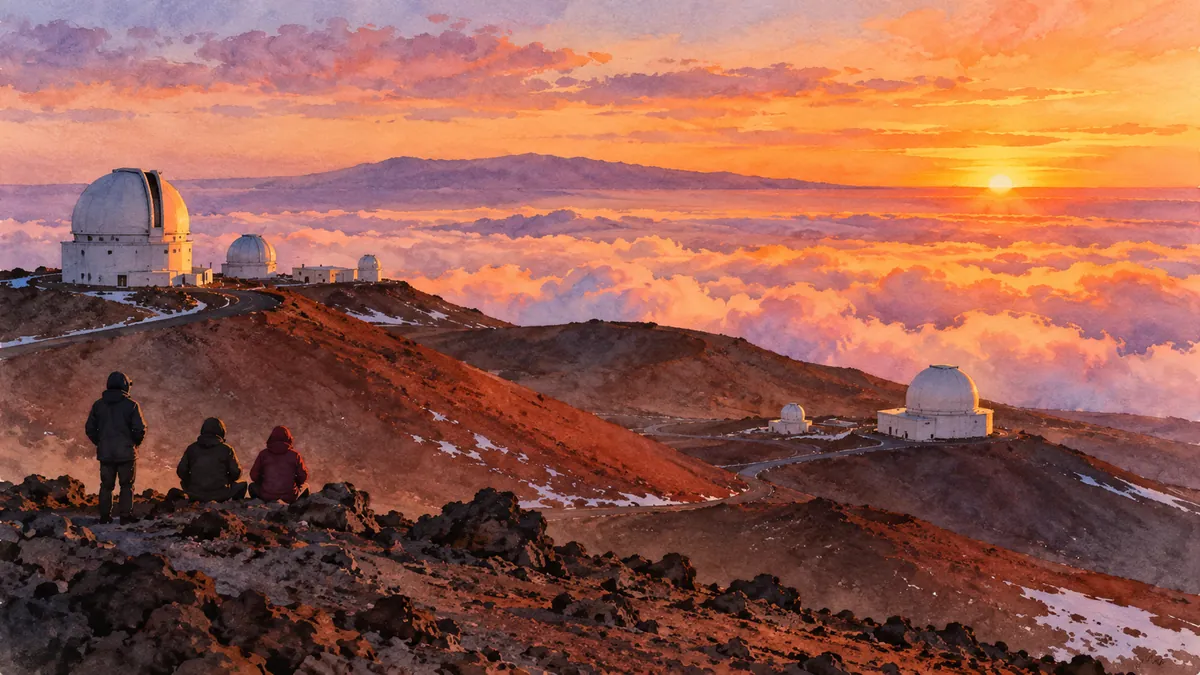
For most adults, yes, as long as you go up to the summit for sunset. You stand at 13,796 feet above a layer of cloud and watch the sun drop behind it, then look at a sky the University of Hawaiʻi describes as clear on about 325 days a year. The catches are real: a summit tour costs $255 to $345 per person, it is near or below freezing after sunset, and nobody stargazes on the summit itself, because it closes to visitors 30 minutes after sunset. Children under 13, pregnant travelers and anyone with a heart or lung condition should stay at or below the Visitor Information Station. For them, a lower-elevation tour from $189 or a free evening at the station still gives most of the sky.
The most-reviewed summit tour on GetYourGuide is the Mauna Kea Summit Sunset & Stargazing Tour, from $289 and rated 4.8/5 from 770 reviews. Check your dates below; departures depend on the weather on the mountain.
What a summit tour gets you for $255 to $345
A summit tour handles the three things that are hard to do yourself: the drive, the cold and the altitude.
The drive. The road is paved only to about 300 yards past the Visitor Information Station at 9,200 feet. The last 4.5 miles to the summit are gravel, and the university requires four-wheel drive (its current safety page says “4WD or AWD”) with low gear on the way down. Most rental contracts ban unpaved roads, so check yours before you plan to drive it. Tours go up in their own 4x4 vans.
The cold. Summit temperatures average 33.9°F in the coolest month, and February nights average 23.5°F, according to the State of Hawaiʻi Data Book. Most summit tours lend parkas: the $289 tour includes parkas, gloves, snacks and hot chocolate.
The altitude. At 14,000 feet there is about 40% less oxygen than at sea level. Tours stop at the Visitor Information Station on the way up so you can adjust; the university recommends at least 30 minutes there.
Here is how the prices compare on the Kona and Hilo sides (prices from, per person, checked October 2026):
- $255, the cheapest summit sunset: Arnott’s Hilo summit tour (4.8/5, 59 reviews). Small groups of up to 13, pickup in Hilo or a meeting point at the Visitor Information Station. The guide points out the sky with a laser; no telescope is listed, jackets are on request, and dinner isn’t included.
- $289, summit plus a telescope: the Summit Sunset & Stargazing Tour (4.8/5, 770 reviews), with pickup at select Kona and Waikoloa locations, parkas, gloves, snacks, hot chocolate and night photos emailed afterwards. It runs 5 to 7.5 hours and takes guests aged 13 to 80. Dinner and tips aren’t included.
- $345, a meal and hotel pickup: Hawaiʻi Forest & Trail’s summit tour with dinner, with a picnic dinner on the mountain and hotel pickup in the Kona area.
The full table of every tour, with what each one includes, is in our Mauna Kea tour cost guide. Our review of the $289 summit tour goes through the evening stop by stop.
Other evenings on and around the mountain, from Saddle Road stargazing sessions to volcano-and-stars days out of Kona and Hilo, are bookable here too:
Who should book the summit, and who should skip it
Book the summit if:
- You are between 13 and 80 and the sunset above the clouds is the reason you came.
- You are staying in Kona or Waikoloa and want pickup near your hotel.
- You are based in Hilo on a budget: the $255 Arnott’s tour gets you to the summit for sunset.
- You would rather not drive a 4x4 on gravel in the dark, or your rental contract rules it out.
Skip the summit if:
- Anyone in your group is under 13. The university advises children under 13 not to go above the Visitor Information Station, and summit tours enforce it (13+ on Hawaiʻi Forest & Trail, Mauna Kea Summit Adventures and Arnott’s; 16 to 75 on Hawaiian Eyes).
- You are pregnant, have high blood pressure or a heart or respiratory condition, or went scuba diving in the past 24 hours. The university lists all of these as reasons to stay at or below the station.
- You dislike cold weather. Even with a parka, the summit after sunset is close to freezing.
For a family with younger children, KapohoKine’s Stellar Explorer from Hilo or Kona costs from $189 (4.4/5, 85 reviews). It does not go to the summit, so all ages can join, and it includes telescopes, jackets and pickup. Our health and safety guide covers altitude sickness and what to wear in more detail.
What can disappoint on Mauna Kea
- The cold. Near or below freezing on the summit after sunset, colder in winter. Our guide to Mauna Kea stargazing in winter covers snow, closures and backup nights.
- You don’t stargaze on the summit. The summit closes to visitors from 30 minutes after sunset until 30 minutes before sunrise. After dark, visitors have to be below the area the university calls Park 2. Tours watch the sunset at the top, then drive down to stargaze; how far down depends on the operator.
- No telescopes at the free station. The Visitor Information Station stopped its nightly telescope program in 2019 because of safety concerns and crowding. Its free Telescope Experience now runs about once a month for the public, by reservation, and both November 2026 dates were already full at the end of October.
- The altitude. At 14,000 feet there is about 40% less oxygen than at sea level, and going up too fast can bring on altitude sickness. Spend at least 30 minutes at the station before going higher.
- A long evening. The $289 tour runs 5 to 7.5 hours, and the summit is a long drive from either coast. Plan an easy next morning.
- Clouds and closures. The cloud layer usually sits well below the summit, which is why the observatories are there, but the summit road can close in bad weather. Check our guide to whether Mauna Kea is open today on the day. Every guided night tour we compared on GetYourGuide has free cancellation, so check the cut-off when you book.
Is the free Visitor Information Station enough on its own?
For families with young children, drivers with an ordinary rental car and travelers on a budget, often yes. The Onizuka Center for International Astronomy Visitor Information Station sits at 9,200 feet on the paved part of the Mauna Kea Access Road. It is open every day from 9 am to 9 pm, with no entrance fee, no registration and free parking.
What you give up: the summit sunset, and a telescope, unless you get one of the monthly Telescope Experience places. Each booking covers up to two adults and three children, once per quarter per party; check-in is at 5:15 pm and the event ends around 8:30 to 9 pm. Arrive 1.5 to 2 hours before sunset if you also want time to acclimatize, and fill up before you leave the coast: the nearest gas stations are about 35 miles from the station.
Our Visitor Information Station guide covers hours and directions, the self-drive vs guided tour breakdown covers rental contracts and the cost of a 4x4, and Big Island stargazing beyond the summit lists every lower-elevation option.
What we would book
- Adults who want the full evening: the $289 summit tour, for the sunset at the top and a telescope afterwards.
- A family with children under 13, or grandparents with health concerns: the $189 Stellar Explorer, or a free evening at the Visitor Information Station if you have your own car.
- Staying in Hilo on a tighter budget: Arnott’s $255 summit tour, accepting a laser talk in place of a telescope.
Time your evening with our sunset times and viewpoints guide, see what will be overhead with the month-by-month night sky guide, and if you are weighing Maui as well, read Mauna Kea vs Haleakalā. Operator by operator, the summit tour operators compared page sets them side by side.
Frequently asked questions
Is Mauna Kea stargazing worth it?
Yes for most adults who go up for the summit sunset: the University of Hawaiʻi counts about 325 clear days a year up there. Skip the summit if you are under 13, pregnant or have a heart or lung condition; a lower-elevation tour or the free Visitor Information Station suits you better. With only one night on the Big Island, it is worth it when the pickup and late return fit around your flights.
Is a Mauna Kea summit tour worth the money?
At $255 to $345 per person, you pay for a 4x4 on the gravel road, warm gear and a guide who manages the altitude. The $289 tour adds a telescope, parkas and gloves; Arnott's $255 tour is the cheapest summit sunset but uses a laser and no telescope.
Can you go stargazing on Mauna Kea without a tour?
Yes. Any rental car can reach the Visitor Information Station at 9,200 feet, which is free and open until 9 pm. Above it you need four-wheel drive, and the summit closes 30 minutes after sunset, so independent stargazing happens lower down anyway.
How cold is Mauna Kea at night?
Near or below freezing on the summit after sunset: State of Hawaiʻi Data Book averages are 33.9°F in the coolest month, and February nights average 23.5°F. Bring a warm jacket, hat and gloves even on a tour that lends parkas, and read our winter stargazing guide before a December to March trip.
Can children go to the Mauna Kea summit?
Not under 13. The university advises children under 13 not to go above the Visitor Information Station, and summit tours enforce it. The $189 Stellar Explorer does not go to the summit and takes all ages.
Do you see the stars from the summit?
No. The summit closes to visitors 30 minutes after sunset, so tours watch the sunset at the top and stargaze lower on the mountain after dark.
Does the Visitor Information Station still have free telescopes?
Not every night. The nightly telescope program stopped in 2019. A free Telescope Experience runs about once a month for the public, by reservation, and places go quickly.
What if it's cloudy?
The cloud layer usually sits well below the summit, so you often look down on it. If the forecast is bad, the GetYourGuide night tours here all offer free cancellation; check the cut-off time on your booking.
Elevations, opening hours, safety advice and the Telescope Experience rules are from the University of Hawaiʻi at Hilo’s Center for Maunakea Stewardship. Summit temperatures are from the State of Hawaiʻi Data Book. Prices, ratings and inclusions are from the operators’ GetYourGuide listings, checked October and November 2026.
See the Universe from Mauna Kea
Join 1,500+ guests who rated Mauna Kea stargazing tours 4.8/5. Summit sunsets, professional telescopes, expert guides — and free cancellation on most tours.
Check Availability & Book